Wednesday, 17 September 2014

Roasted Veggies with Bacon and Garlic

I hesitated about posting this recipe here, I mean, it's got bacon it in, which I know isn't the healthiest option.  But, in my flavor-loving defense, I used center-cut bacon and each serving calls for just one strip of bacon- unless you eat the whole pan in one sitting.  Which you might want to do.  After our initial serving at dinner on Monday, my husband actually brought the pan to the table and we finished it off straight from that bad boy!  It's that good.  


INGREDIENTS
(serves 4)

brussel sprouts (about half a pound)
cauliflower (half a head)
small potatoes (6)
garlic (3 cloves)
center-cut bacon (4 slices)
olive oil (1 tblsp)
salt and pepper (to taste- I give it one small sprinkling, probably l/2 tsp)

DIRECTIONS

Preheat oven to 400 degrees.  The veggies cook for 30 minutes, turning once halfway through.  You cook the bacon and garlic on the stove under low-medium heat.  Then, combine.  Details below. 

Wash and pat dry your produce.  


Then chop the veggies into small, similar-sized pieces.  I halve the brussel sprouts, cut the potatoes into 6 pieces, and the cauliflower into about 1 1/2 inch chunks. 


Place the food onto a baking sheet, drizzle with olive oil and sprinkle on salt and pepper.  


Cook for about 15 minutes, then take it out and flip the veggies.  Cook for another 15 minutes.  The veggies are done when they are fork tender.  Don't overcook or they will burn or get soggy. 


When the veggies are almost done cooking, dice 4 slices of bacon into small pieces and mince the garlic.  Over low to medium heat, cook the bacon and, when the bacon is almost done, add in the garlic.  Garlic burns easily, so you don't need to cook it for more than a minute or two.  


Using a slotted spoon, put the bacon and garlic mixture onto a paper towel to drain the excess oil.  

When the veggies are done, remove the baking sheet from the oven and mix in the bacon and garlic.  Now it's ready to eat! 
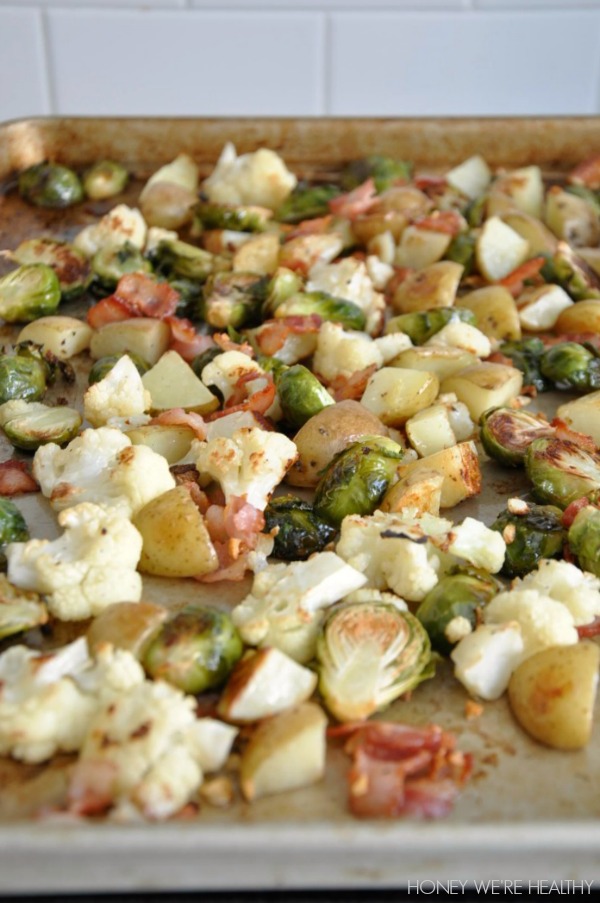

Oh yeah, this is good!  I'm already planning on making this side dish for Thanksgiving!  I know my family will love it!

The roasted vegetables on their own are very good- so leave the bacon off if you want to save calories and fat.


_____________


Sponsored by:
PopAds.net - The Best Popunder Adnetwork

Monday, 15 September 2014

Will your wireless router give you cancer?


If you pick up a magnet and move it up and down with your hand, you will be creating electromagnetic radiation. The faster you move the magnet, the higher the frequency of the radiation you create. The higher the frequency of the radiation, the lower is its wavelength. High frequency is also associated with high radiation strength, where strength can be measured in watts (W).

We are constantly bombarded by electromagnetic radiation, which is usually classified based on its frequency (and also wavelength, since frequency and wavelength are inversely proportional). The main types of electromagnetic waves, in order of increasing frequency, are: radio waves, microwaves, infrared radiation, visible light, ultraviolet radiation, X-rays, and gamma rays.

There has been a large amount of research on the health effects of wireless equipment, including wireless routers (figure below from Bestwirelessrouterreview.com), because of the electromagnetic radiation that they emit. Wireless equipment uses electromagnetic radiation of the radio waves type.


In developing countries, wireless routers are ubiquitous. They are found everywhere – at home, in hotels and businesses, and even in public parks. They allow wireless devices to connect to the Internet, by creating one or more “WiFi hotspots”.

The strength of the radiation emitted by wireless routers, when it reaches humans, is much lower than that emitted by mobile phones. One of the reasons for this is the lower strength of the radiation emitted by wireless routers, which can go from 30 to 500 milliwatts (mW); versus 125 mW to 2 W for mobile phones.

But the main reason for the lower strength of the radiation emitted by wireless routers, when it reaches humans, is that wireless routers normally are located farther away from humans than mobile phones. Radiation strength goes down according to the inverse-square law; i.e., proportionally to 1 divided by the distance between source and destination squared.

Given this, it has been estimated () that the exposure to 1 full year of radiation from a wireless router at home is equivalent, in terms of radiation reaching the body, to 20 minutes of exposure to the radiation emitted by a mobile phone.

If the radiation from wireless routers were to cause cancer, so should the radiation from mobile phones. So, what about mobile phones? Do they cause cancer?

In spite of a large amount of research conducted on the subject, no conclusive evidence has been found that the radiation from mobile phones causes cancer. A representative example of this research is a large Danish study (), whose results have recently been replicated.

Mobile phone radiation, like wireless router radiation, is currently classified by the International Agency for Research on Cancer (IARC) in Group 2B, namely “possibly carcinogenic”. This carries a recommendation of “more research”. Caffeic acid, found in coffee, is also in this group. It is useful to note that neither mobile phone nor wireless router radiation are classified in Group 2A, which is the “probably carcinogenic” IARC group.

When one considers the accumulated evidence regarding cancer risk associated with all types of electromagnetic radiation, the biggest concern by far is sunburn from ultraviolet radiation. The evidence suggests that it causes skin cancer. Chronic non-sunburn exposure to natural ultraviolet radiation, on the other hand, seems protective against most types of cancer (skin cancer included).

Will your wireless router give you cancer? I don’t think so.

Sponsored by:
PopAds.net - The Best Popunder Adnetwork

Sunday, 14 September 2014

Pumpkin Pie Oats

As September progresses, it's gradually getting colder, the trees are changing colour and different kinds of pumpkins are starting to pop up here and there in the grocery stores. My favourite winter squash is the butternut squash; sweet, creamy and incredibly versatile! I promise to share my best pumpkin soup recipe with you in the future, but for now these pumpkin pie oats will have to do. They're well worth a try!


Pumpkin Pie Oats


1/2 cup oats

1 cup almond milk

1 tsp pumpkin pie spice

3 tbsp puréed pumpkin or butternut squash

3-4 small dates, mashed or chopped or 1 tbsp liquid sweetener of choice

A pinch of salt

How to:
1. Add oats, almond milk and a dash of salt to a small saucepan and bring to the boil. 
2. Let simmer on a low heat for a few minutes until it has thickened up a bit. 
3. Add the pumpkin pie spice, pumpkin purée and dates and stir until they have been well incorporated. 
4. Cook for a few more minutes or until you've reached your desired consistency. pour the porridge into a bowl and top with yummy fruit, nuts or nut butter!

Sponsored by:
PopAds.net - The Best Popunder Adnetwork

Monday, 8 September 2014

Thoughts on the McDougall Advanced Study Weekend

For those of you who aren't familiar with him, Dr. John McDougall is a doctor and diet/health advocate who recommends a very low fat, high starch, whole food vegan diet to control weight and avoid chronic disease.  He's been at it for a long time, and he's a major figure in the "plant-based diet" community (i.e., a diet including little or no animal foods).

Dr. McDougall invited me to participate in his 3-day Advanced Study Weekend retreat in Santa Rosa, CA.  My job was to give my talk on insulin and obesity, and participate in a panel discussion/debate with Dr. McDougall in which we sorted through issues related to low-carb, Paleo, and the health implications of eating animal foods.  I was glad to receive the invitation, because I don't see myself as a diet partisan, and I believe that my evidence-based information is applicable to a variety of diet styles.  I saw the Weekend as an opportunity to extend my thoughts to a new community, challenge myself, and maybe even learn a thing or two.  It was particularly interesting to compare and contrast the Advanced Study Weekend with the Ancestral Health Symposium, which is more Paleo- and low-carb-friendly.

General Observations

The attendees were a lot older than AHS attendees.  I estimate that most of them were in their 60s, although there were some young people in attendance.

I don't place too much emphasis on peoples' personal appearance at conferences like this.  You don't know what a person's background, genetics, or personal struggles may be, you don't know how closely they adhere to the program, and you don't know to what degree a group of people might be self-selected for particular traits*.  But I will note that Dr. McDougall, his family, and many of the other starch-based/plant-based diet advocates tended to be extremely lean with low fat and muscle mass.  They also tended to have a healthy and energetic appearance and demeanor.  As I would expect, decades of exceptionally high starch intake hasn't made them obese or obviously ill.

Read more »

Sponsored by:
PopAds.net - The Best Popunder Adnetwork

Thursday, 4 September 2014

What about the Other Weight Loss Diet Study??

The same day the low-fat vs low-carb study by Bazzano and colleagues was published, the Journal of the American Medical Association published a meta-analysis that compared the effectiveness of "named diet programs".  Many people have interpreted this study as demonstrating that low-carbohydrate and low-fat diets are both effective for weight loss, and that we simply need to pick a diet and stick with it, but that's not really what the study showed.  Let's take a closer look.

Johnston and colleagues sifted through PubMed for studies that evaluated "named diet programs", such as Ornish, Atkins, LEARN, Weight Watchers, etc (1).  In addition, the methods state that they included any study as low-carbohydrate that recommended less than 40% of calories from carbohydrate, was funded by the Atkins foundation, or was "Atkins-like".  These criteria weren't extended to the low-fat diet: only studies of name-brand low-fat diets like the Ornish diet were included, while the meta-analysis excluded low-fat diet studies whose guidelines were based on recommendations from government and academic sources, even though the latter group represents the majority of the evidence we have for low-fat diets.  The inclusion criteria were therefore extremely asymmetrical in how they represented low-carb and low-fat diets.  This fact explains the unusual findings of the paper.

The abstract immediately activated my skeptic alarm, because it states that at the one-year mark, low-carbohydrate diets and low-fat diets both led to a sustained weight loss of about 16 pounds (7.3 kg).  Based on my understanding of the weight loss literature, that number seems far too high for the low-fat diet, and also too high for the low-carbohydrate diet.

Read more »

Sponsored by:
PopAds.net - The Best Popunder Adnetwork

Tuesday, 2 September 2014

Spiced Up Rawnola

I know I haven't been updating much as of late, but school has just started and is really keeping me busy as well as keeping me from blogging. I thought it'd be nice to get away from the schoolwork though (i. e. desperately looking for distractions) so yesterday I made a batch of -believe it or not- rawnola! Yup, you heard it right, this rawnola is in fact RAW, meaning it's packed with nutrients and vitamins otherwise lost when you bake your granola, meaning it's the perfect "healthier" alternative to your regular "ALL NATURAL SUPER-GOOD-FOR-YOU GRANOLA" (pff, they put so much crap in breakfast cereal nowadays I wouldn't know where to begin). If you really can't live without that extra crunchiness you get from baking the granola, I suggest you go check out this post instead. There I've shared my favourite granola recipe, one that is actually healthy for real, gluten-free AND refined sugar free. Either way you're in for a treat. Here we go.


Spiced Up Rawnola 


50g (1/2 cup) raw oats (most oats have been steamed for longer shelf life, the fully raw ones are almost impossible to find though, so any oats you have will work just fine for this recipe)

140g (about 1 cup packed) pitted medjool dates

40g (2 big) dried figs

20g (3 tbsp) whole flax seeds

1/2 tsp ground cardamom

1/2 tsp ground cinnamon

Or any spices/superfood powders you have at home!

Optional: A handful of shredded coconut/chopped nuts/cacao nibs

1. Place all ingredients except for the flax seeds (this is very important that you don't, flaxseed oil goes rancid very quickly!) and pulse until you have a chunky mixture that holds together in smaller clumps, like real granola does. Transfer to a jar or bowl, stir in the flax seeds (or incorporate them using your hands) and store in the fridge or freezer.

Sponsored by:
PopAds.net - The Best Popunder Adnetwork

Monday, 1 September 2014

Low-carbohydrate vs. Low-fat diets for Weight Loss: New Evidence

A new high-profile study compared the weight loss and cardiovascular effects of a low-carbohydrate diet vs. a low-fat diet.  Although many studies have done this before, this one is novel enough to add to our current understanding of diet and health.  Unlike most other studies of this nature, diet adherence was fairly good, and carbohydrate restriction produced greater weight loss and cardiovascular risk factor improvements than fat restriction at the one-year mark.  Yet like previous studies, neither diet produced very impressive results.

The Study

Lydia A. Bazzano and colleagues at Tulane University randomly assigned 148 obese men and women without cardiovascular disease into two groups (1):
  1. Received instructions to eat less than 40 grams of carbohydrate per day, plus one low-carbohydrate meal replacement per day.  No specific advice to alter calorie intake.  Met regularly with dietitians to explain the dietary changes and maintain motivation.
  2. Received instructions to eat less than 30 percent of calories from fat, less than 7 percent of calories as saturated fat, and 55 percent of calories from carbohydrate, plus one low-fat meal replacement per day.  No specific advice to alter calorie intake.  This is based on NCEP guidelines, which are actually designed for cardiovascular risk reduction and not weight loss.  Met regularly with dietitians to explain the dietary changes and maintain motivation.
Participants were followed up for one year, with data reported for 3 month, 6 month, and 12 month timepoints.  This study actually measured body fat percentage, but unfortunately did so using bioelectrical impedance (like on some bathroom scales), which is essentially meaningless in this context.

Results

Read more »

Sponsored by:
PopAds.net - The Best Popunder Adnetwork