My statements about carbohydrate and insulin in the previous post seem to have kicked up some dust! Some people are even suggesting I've gone low-fat! I'm going to take this opportunity to be more specific about my positions.
I do not think that post-meal insulin spikes contribute to obesity, and they may even oppose it. Elevated fasting insulin is a separate issue-- that's a marker of insulin resistance. It's important not to confuse the two. Does insulin resistance contribute to obesity? I don't know, but it's hypothetically possible since insulin acts like leptin's kid brother in some ways. As far as I can tell, starch per se and post-meal insulin spikes do not lead to insulin resistance.
Read more »
Tuesday, 17 May 2011


Monday, 16 May 2011
Book review: Biology for Bodybuilders
The photos below show Doug Miller and his wife, Stephanie Miller. Doug is one of the most successful natural bodybuilders in the U.S.A. today. He is also a manager at an economics consulting firm and an entrepreneur. As if these were not enough, now he can add book author to his list of accomplishments. His book, Biology for Bodybuilders, has just been published.

Doug studied biochemistry, molecular biology, and economics at the undergraduate level. His co-authors are Glenn Ellmers and Kevin Fontaine. Glenn is a regular commenter on this blog, a professional writer, and a certified Strength and Conditioning Specialist. Dr. Fontaine is an Associate Professor at the Johns Hopkins University’s School of Medicine and Bloomberg School of Public Health.
Biology for Bodybuilders is written in the first person by Doug, which is one of the appealing aspects of the book. This also allows Doug to say that his co-authors disagree with him sometimes, even as he outlines what works for him. Both Glenn and Kevin are described as following Paleolithic dieting approaches. Doug follows a more old school bodybuilding approach to dieting – e.g., he eats grains, and has multiple balanced meals everyday.
This relaxed approach to team writing neutralizes criticism from those who do not agree with Doug, at least to a certain extent. Maybe it was done on purpose; a smart idea. For example, I do not agree with everything Doug says in the book, but neither do Doug’s co-authors, by his own admission. Still, one thing we all have to agree with – from a competitive sports perspective, no one can question success.
At less than 120 pages, the book is certainly not encyclopedic, but it is quite packed with details about human physiology and metabolism for a book of this size. The scientific details are delivered in a direct and simple manner, through what I would describe as very good writing.
Doug has interesting ideas on how to push his limits as a bodybuilder. For example, he likes to train for muscle hypertrophy at around 20-30 lbs above his contest weight. Also, he likes to exercise at high repetition ranges, which many believe is not optimal for muscle growth. He does that even for mass building exercises, such as the deadlift. In this video he deadlifts 405 lbs for 27 repetitions.
Here it is important to point out that whether one is working out in the anaerobic range, which is where muscle hypertrophy tends to be maximized, is defined not by the number of repetitions but by the number of seconds a muscle group is placed under stress. The anaerobic range goes from around 20 to 120 seconds. If one does many repetitions, but does them fast, he or she will be in the anaerobic range. Incidentally, this is the range of strength training at which glycogen depletion is maximized.
I am not a bodybuilder, nor do I plan on becoming one, but I do admire athletes that excel in narrow sports. Also, I strongly believe in the health-promoting effects of moderate glycogen-depleting exercise, which includes strength training and sprints. Perhaps what top athletes like Doug do is not exactly optimal for long-term health, but it certainly beats sedentary behavior hands down. Or maybe top athletes will live long and healthy lives because the genetic makeup that allows them to be successful athletes is also conducive to great health.
In this respect, however, Doug is one of the people who have gotten the closest to convincing me that genes do not influence so much what one can achieve as a bodybuilder. In the book he shows a photo of himself at age 18, when he apparently weighed not much more than 135 lbs. Now, in his early 30s, he weighs 210-225 lbs during the offseason, at a height of 5'9". He has achieved this without taking steroids. Maybe he is a good example of compensatory adaptation, where obstacles lead to success.
If you are interested in natural bodybuilding, and/or the biology behind it, this book is highly recommended!

(Source: www.dougmillerpro.com)
Doug studied biochemistry, molecular biology, and economics at the undergraduate level. His co-authors are Glenn Ellmers and Kevin Fontaine. Glenn is a regular commenter on this blog, a professional writer, and a certified Strength and Conditioning Specialist. Dr. Fontaine is an Associate Professor at the Johns Hopkins University’s School of Medicine and Bloomberg School of Public Health.
Biology for Bodybuilders is written in the first person by Doug, which is one of the appealing aspects of the book. This also allows Doug to say that his co-authors disagree with him sometimes, even as he outlines what works for him. Both Glenn and Kevin are described as following Paleolithic dieting approaches. Doug follows a more old school bodybuilding approach to dieting – e.g., he eats grains, and has multiple balanced meals everyday.
This relaxed approach to team writing neutralizes criticism from those who do not agree with Doug, at least to a certain extent. Maybe it was done on purpose; a smart idea. For example, I do not agree with everything Doug says in the book, but neither do Doug’s co-authors, by his own admission. Still, one thing we all have to agree with – from a competitive sports perspective, no one can question success.
At less than 120 pages, the book is certainly not encyclopedic, but it is quite packed with details about human physiology and metabolism for a book of this size. The scientific details are delivered in a direct and simple manner, through what I would describe as very good writing.
Doug has interesting ideas on how to push his limits as a bodybuilder. For example, he likes to train for muscle hypertrophy at around 20-30 lbs above his contest weight. Also, he likes to exercise at high repetition ranges, which many believe is not optimal for muscle growth. He does that even for mass building exercises, such as the deadlift. In this video he deadlifts 405 lbs for 27 repetitions.
Here it is important to point out that whether one is working out in the anaerobic range, which is where muscle hypertrophy tends to be maximized, is defined not by the number of repetitions but by the number of seconds a muscle group is placed under stress. The anaerobic range goes from around 20 to 120 seconds. If one does many repetitions, but does them fast, he or she will be in the anaerobic range. Incidentally, this is the range of strength training at which glycogen depletion is maximized.
I am not a bodybuilder, nor do I plan on becoming one, but I do admire athletes that excel in narrow sports. Also, I strongly believe in the health-promoting effects of moderate glycogen-depleting exercise, which includes strength training and sprints. Perhaps what top athletes like Doug do is not exactly optimal for long-term health, but it certainly beats sedentary behavior hands down. Or maybe top athletes will live long and healthy lives because the genetic makeup that allows them to be successful athletes is also conducive to great health.
In this respect, however, Doug is one of the people who have gotten the closest to convincing me that genes do not influence so much what one can achieve as a bodybuilder. In the book he shows a photo of himself at age 18, when he apparently weighed not much more than 135 lbs. Now, in his early 30s, he weighs 210-225 lbs during the offseason, at a height of 5'9". He has achieved this without taking steroids. Maybe he is a good example of compensatory adaptation, where obstacles lead to success.
If you are interested in natural bodybuilding, and/or the biology behind it, this book is highly recommended!
Sponsored by:
Friday, 13 May 2011
Healthy Skeptic Podcast and Reader Questions
Chris Kresser, Danny Roddy and I just finished recording the podcast that will be released on May 24th. It went really well, and we think you'll find it informative and maybe even practical!
Unfortunately, we only got around to answering three of the questions I had selected:
Read more »
Unfortunately, we only got around to answering three of the questions I had selected:
- How does one lose fat?
- What do I (Stephan) eat?
- Why do many people gain fat with age, especially postmenopausal women?
Read more »
Sponsored by:
Monday, 9 May 2011
Looking for a good orthodontist? My recommendation is Dr. Meat
The figure below is one of many in Weston Price’s outstanding book Nutrition and Physical Degeneration showing evidence of teeth crowding among children whose parents moved from a traditional diet of minimally processed foods to a Westernized diet.

Tooth crowding and other forms of malocclusion are widespread and on the rise in populations that have adopted Westernized diets (most of us). Some blame it on dental caries, particularly in early childhood; dental caries are also a hallmark of Westernized diets. Varrela (2007), however, in a study of Finnish skulls from the 15th and 16th centuries found evidence of dental caries, but not of malocclusion, which Varrela reported as fairly high in modern Finns.
Why does malocclusion occur at all in the context of Westernized diets? Lombardi (1982) put forth an evolutionary hypothesis:
So what is one to do? Apparently getting babies to eat meat is not a bad idea. They may well just chew on it for a while and spit it out. The likelihood of meat inducing dental caries is very low, as most low carbers can attest. (In fact, low carbers who eat mostly meat often see dental caries heal.)
Concerned about the baby choking on meat? At the time of this writing a Google search yielded this: No results found for “baby choked on meat”. Conversely, Google returned 219 hits for “baby choked on milk”.
What if you have a child with crowded teeth as a preteen or teen? Too late? Should you get him or her to use “cute” braces? Our daughter had crowded teeth a few years ago, as a preteen. It overlapped with the period of my transformation, which meant that she started having a lot more natural foods to eat. There were more of those around, some of which require serious chewing, and less industrialized soft foods. Those natural foods included hard-to-chew beef cuts, served multiple times a week.
We noticed improvement right away, and in a few years the crowding disappeared. Now she has the kind of smile that could land her a job as a toothpaste model:

The key seems to be to start early, in developmental years. If you are an adult with crowded teeth, malocclusion may not be solved by either tough foods or braces. With braces, you may even end up with other problems (see this).

Tooth crowding and other forms of malocclusion are widespread and on the rise in populations that have adopted Westernized diets (most of us). Some blame it on dental caries, particularly in early childhood; dental caries are also a hallmark of Westernized diets. Varrela (2007), however, in a study of Finnish skulls from the 15th and 16th centuries found evidence of dental caries, but not of malocclusion, which Varrela reported as fairly high in modern Finns.
Why does malocclusion occur at all in the context of Westernized diets? Lombardi (1982) put forth an evolutionary hypothesis:
“In modern man there is little attrition of the teeth because of a soft, processed diet; this can result in dental crowding and impaction of the third molars. It is postulated that the tooth-jaw size discrepancy apparent in modern man as dental crowding is, in primitive man, a crucial biologic adaptation imposed by the selection pressures of a demanding diet that maintains sufficient chewing surface area for long-term survival. Selection pressures for teeth large enough to withstand a rigorous diet have been relaxed only recently in advanced populations, and the slow pace of evolutionary change has not yet brought the teeth and jaws into harmonious relationship.”
So what is one to do? Apparently getting babies to eat meat is not a bad idea. They may well just chew on it for a while and spit it out. The likelihood of meat inducing dental caries is very low, as most low carbers can attest. (In fact, low carbers who eat mostly meat often see dental caries heal.)
Concerned about the baby choking on meat? At the time of this writing a Google search yielded this: No results found for “baby choked on meat”. Conversely, Google returned 219 hits for “baby choked on milk”.
What if you have a child with crowded teeth as a preteen or teen? Too late? Should you get him or her to use “cute” braces? Our daughter had crowded teeth a few years ago, as a preteen. It overlapped with the period of my transformation, which meant that she started having a lot more natural foods to eat. There were more of those around, some of which require serious chewing, and less industrialized soft foods. Those natural foods included hard-to-chew beef cuts, served multiple times a week.
We noticed improvement right away, and in a few years the crowding disappeared. Now she has the kind of smile that could land her a job as a toothpaste model:

The key seems to be to start early, in developmental years. If you are an adult with crowded teeth, malocclusion may not be solved by either tough foods or braces. With braces, you may even end up with other problems (see this).
Sponsored by:
Sunday, 8 May 2011
Ask Me a Question
On May 13th, I'll be recording a podcast with Chris Kresser of The Healthy Skeptic. Chris interviewed me about a year ago, and I thought it went well. Chris is a good host and asks interesting questions.
This time around, we're going to do things a bit differently. I'll start with a little overview of my current thoughts on obesity, then we'll answer reader questions. The show is going to be mostly about obesity and related matters, but I may answer a couple of questions that aren't related to obesity if they're especially interesting. There are two ways to leave questions: either in the comments section of this post, or the comments section of Chris's post. The show will air on May 24th.
Read more »
This time around, we're going to do things a bit differently. I'll start with a little overview of my current thoughts on obesity, then we'll answer reader questions. The show is going to be mostly about obesity and related matters, but I may answer a couple of questions that aren't related to obesity if they're especially interesting. There are two ways to leave questions: either in the comments section of this post, or the comments section of Chris's post. The show will air on May 24th.
Read more »
Sponsored by:
Friday, 6 May 2011
Food Reward: a Dominant Factor in Obesity, Part II
How to Make a Rat Obese
Rodents are an important model organism for the study of human obesity. To study obesity in rodents, you have to make them fat first. There are many ways to do this, from genetic mutations, to brain lesions, to various diets. However, the most rapid and effective way to make a normal (non-mutant, non-lesioned) rodent obese is the "cafeteria diet." The cafeteria diet first appeared in the medical literature in 1976 (1), and was quickly adopted by other investigators. Here's a description from a recent paper (2):
Investigators have known for decades that the cafeteria diet is a highly effective way of producing obesity in rodents, but what was interesting about this particular study from my perspective is that it compared the cafeteria diet to three other commonly used rodent diets: 1) standard, unpurified chow; 2) a purified/refined high-fat diet; 3) a purified/refined low-fat diet designed as a comparator for the high-fat diet. All three of these diets were given as homogeneous pellets, and the textures range from hard and fibrous (chow) to soft and oily like cookie dough (high-fat). The low-fat diet contains a lot of sugar, the high-fat diet contains a modest amount of sugar, and the chow diet contains virtually none. The particular high-fat diet in this paper (Research Diets D12451, 45% fat, which is high for a rat) is commonly used to produce obesity in rats, although it's not always very effective. The 60% fat version is more effective.
Consistent with previous findings, rats on every diet consumed the same number of calories over time... except the cafeteria diet-fed rats, which ate 30% more than any of the other groups. Rats on every diet gained fat compared to the unpurified chow group, but the cafeteria diet group gained much more than any of the others. There was no difference in fat gain between the purified high-fat and low-fat diets.
So in this paper, they compared two refined diets with vastly different carb:fat ratios and different sugar contents, and yet neither equaled the cafeteria diet in its ability to increase food intake and cause fat gain. The fat, starch and sugar content of the cafeteria diet was not able to fully explain its effect on fat gain. However, each diets' ability to cause fat gain correlated with its respective food reward qualities. Refined diets high in fat or sugar caused fat gain in rats relative to unpurified chow, but were surpassed by a diet containing a combination of fat, sugar, starch, salt, free glutamate (umami), interesting textures and pleasant and invariant aromas.
Although the cafeteria diet is the most effective at causing obesity in rodents, it's not commonly used because it's a lot more work than feeding pellets, and it introduces a lot of variability into experiments because each rat eats a different combination of foods.
How to Make an Obese Human Lean
In 1965, the Annals of the New York Academy of Sciences published a very unusual paper (3). Here is the stated goal of the investigators:
 It's a machine that dispenses bland liquid food through a straw, at the push of a button. They don't give any information on the composition of the liquid diet, beyond remarking that "carbohydrate supplied 50 per cent of the calories, protein 20 per cent and fat 30 per cent. the formula contained vitamins and minerals in amount adequate for daily maintenance."
Volunteers were given access to the machine and allowed to consume as much of the liquid diet as they wanted, but no other food. Since they were in a hospital setting, the investigators could be confident that the volunteers ate nothing else.
The first thing they report is what happened when they fed two lean people using the machine, for 16 or 9 days. Both of them maintained their typical calorie intake (~3,075 and ~4,430 kcal per day) and maintained a very stable weight during this period.
Next, the investigators did the same experiment using two "grossly obese" volunteers. Again, they were asked to "obtain food from the machine whenever hungry." Over the course of the first 18 days, the first (male) volunteer consumed a meager 275 calories per day. The second (female) volunteer consumed a ridiculously low 144 calories per day over the course of 12 days, losing 23 pounds. Without showing data, the investigators remarked that an additional three obese volunteers "showed a similar inhibition of calorie intake when fed by machine."
The first volunteer continued eating bland food from the machine for a total of 70 days, losing approximately 70 pounds. After that, he was sent home with the formula and instructed to drink 400 calories of it per day, which he did for an additional 185 days, after which his total weight loss was 200 lbs. The investigators remarked that "during all this time weight was steadily lost and the patient never complained of hunger or gastrointestinal discomfort." This is truly a starvation-level calorie intake, and to eat it continually for 255 days without hunger suggests that something rather interesting was happening in this man's body.
This machine-feeding regimen was nearly as close as one can get to a diet with no rewarding properties whatsoever. Although it contained carbohydrate and fat, it did not contain any flavor or texture to associate them with, and thus the reward value of the diet was minimized. As one would expect if food reward influences the body fat setpoint, lean volunteers maintained starting weight and a normal calorie intake, while their obese counterparts rapidly lost a massive amount of fat and reduced calorie intake dramatically without hunger. This suggests that obesity is not entirely due to a "broken" metabolism (although that may still contribute), but also at least in part to a heightened sensitivity to food reward in susceptible people. This also implies that obesity may not be a disorder, but rather a normal response to the prevailing dietary environment in affluent nations.
A second study by Dr. Michel Cabanac in 1976 confirmed that reducing food reward (by feeding bland food) lowers the fat mass setpoint in humans, using a clever method that I won't discuss for the sake of brevity (4). I learned about both of these studies through the writing of Dr. Seth Roberts, author of The Shangri-La Diet. I'd also like to thank Dr. Stephen Benoit, a researcher in the food reward field, for talking through these ideas with me to make sure I wasn't misinterpreting them.
I'd like to briefly remark that there's an anatomical basis for the idea of two-way communication between brain regions that determine reward and those that control body fatness. It's well known that the latter influence the former (think about your drive to obtain food after you've just eaten a big meal vs. after you've skipped a meal), but there are also connections from the former to the latter via a brain region called the lateral hypothalamus. The point is that it's anatomically plausible that food reward determines in part the amount of body fat a person carries.
Some people may be inclined to think "well, if food tastes bad, you eat less of it; so what!" Although that may be true to some extent, I don't think it can explain the fact that bland diets affect the calorie intake of lean and obese people differently. To me, that implies that highly rewarding food increases the body fat setpoint in susceptible people, and that food with few rewarding properties allows them to return to a leaner state.
In the next few posts, I'll describe how food reward explains the effectiveness of many popular fat loss diets, I'll describe how this hypothesis fits in with the diets and health of non-industrial cultures, and I'll outline new dietary strategies for preventing and treating obesity and certain forms of metabolic dysfunction.
Rodents are an important model organism for the study of human obesity. To study obesity in rodents, you have to make them fat first. There are many ways to do this, from genetic mutations, to brain lesions, to various diets. However, the most rapid and effective way to make a normal (non-mutant, non-lesioned) rodent obese is the "cafeteria diet." The cafeteria diet first appeared in the medical literature in 1976 (1), and was quickly adopted by other investigators. Here's a description from a recent paper (2):
In this model, animals are allowed free access to standard chow and water while concurrently offered highly palatable, energy dense, unhealthy human foods ad libitum.In other words, they're given an unlimited amount of human junk food in addition to their whole food-based "standard chow." In this particular paper, the junk foods included Froot Loops, Cocoa Puffs, peanut butter cookies, Reese's Pieces, Hostess Blueberry MiniMuffins, Cheez-its, nacho cheese Doritos, hot dogs, cheese, wedding cake, pork rinds, pepperoni slices and other industrial delicacies. Rats exposed to this food almost completely ignored their healthier, more nutritious and less palatable chow, instead gorging on junk food and rapidly attaining an obese state.
Investigators have known for decades that the cafeteria diet is a highly effective way of producing obesity in rodents, but what was interesting about this particular study from my perspective is that it compared the cafeteria diet to three other commonly used rodent diets: 1) standard, unpurified chow; 2) a purified/refined high-fat diet; 3) a purified/refined low-fat diet designed as a comparator for the high-fat diet. All three of these diets were given as homogeneous pellets, and the textures range from hard and fibrous (chow) to soft and oily like cookie dough (high-fat). The low-fat diet contains a lot of sugar, the high-fat diet contains a modest amount of sugar, and the chow diet contains virtually none. The particular high-fat diet in this paper (Research Diets D12451, 45% fat, which is high for a rat) is commonly used to produce obesity in rats, although it's not always very effective. The 60% fat version is more effective.
Consistent with previous findings, rats on every diet consumed the same number of calories over time... except the cafeteria diet-fed rats, which ate 30% more than any of the other groups. Rats on every diet gained fat compared to the unpurified chow group, but the cafeteria diet group gained much more than any of the others. There was no difference in fat gain between the purified high-fat and low-fat diets.
So in this paper, they compared two refined diets with vastly different carb:fat ratios and different sugar contents, and yet neither equaled the cafeteria diet in its ability to increase food intake and cause fat gain. The fat, starch and sugar content of the cafeteria diet was not able to fully explain its effect on fat gain. However, each diets' ability to cause fat gain correlated with its respective food reward qualities. Refined diets high in fat or sugar caused fat gain in rats relative to unpurified chow, but were surpassed by a diet containing a combination of fat, sugar, starch, salt, free glutamate (umami), interesting textures and pleasant and invariant aromas.
Although the cafeteria diet is the most effective at causing obesity in rodents, it's not commonly used because it's a lot more work than feeding pellets, and it introduces a lot of variability into experiments because each rat eats a different combination of foods.
How to Make an Obese Human Lean
In 1965, the Annals of the New York Academy of Sciences published a very unusual paper (3). Here is the stated goal of the investigators:
The study of food intake in man is fraught with difficulties which result from the enormously complex nature of human eating behavior. In man, in contrast to lower animals, the eating process involves an intricate mixture of physiologic, psychologic, cultural and esthetic considerations. People eat not only to assuage hunger, but because of the enjoyment of the meal ceremony, the pleasures of the palate and often to gratify unconscious needs that are hard to identify. Because of inherent difficulties in studying human food intake in the usual setting, we have attempted to develop a system that would minimize the variables involved and thereby improve the chances of obtaining more reliable and reproducible data.Here's a photo of their "system":
 It's a machine that dispenses bland liquid food through a straw, at the push of a button. They don't give any information on the composition of the liquid diet, beyond remarking that "carbohydrate supplied 50 per cent of the calories, protein 20 per cent and fat 30 per cent. the formula contained vitamins and minerals in amount adequate for daily maintenance."
Volunteers were given access to the machine and allowed to consume as much of the liquid diet as they wanted, but no other food. Since they were in a hospital setting, the investigators could be confident that the volunteers ate nothing else.
The first thing they report is what happened when they fed two lean people using the machine, for 16 or 9 days. Both of them maintained their typical calorie intake (~3,075 and ~4,430 kcal per day) and maintained a very stable weight during this period.
Next, the investigators did the same experiment using two "grossly obese" volunteers. Again, they were asked to "obtain food from the machine whenever hungry." Over the course of the first 18 days, the first (male) volunteer consumed a meager 275 calories per day. The second (female) volunteer consumed a ridiculously low 144 calories per day over the course of 12 days, losing 23 pounds. Without showing data, the investigators remarked that an additional three obese volunteers "showed a similar inhibition of calorie intake when fed by machine."
The first volunteer continued eating bland food from the machine for a total of 70 days, losing approximately 70 pounds. After that, he was sent home with the formula and instructed to drink 400 calories of it per day, which he did for an additional 185 days, after which his total weight loss was 200 lbs. The investigators remarked that "during all this time weight was steadily lost and the patient never complained of hunger or gastrointestinal discomfort." This is truly a starvation-level calorie intake, and to eat it continually for 255 days without hunger suggests that something rather interesting was happening in this man's body.
This machine-feeding regimen was nearly as close as one can get to a diet with no rewarding properties whatsoever. Although it contained carbohydrate and fat, it did not contain any flavor or texture to associate them with, and thus the reward value of the diet was minimized. As one would expect if food reward influences the body fat setpoint, lean volunteers maintained starting weight and a normal calorie intake, while their obese counterparts rapidly lost a massive amount of fat and reduced calorie intake dramatically without hunger. This suggests that obesity is not entirely due to a "broken" metabolism (although that may still contribute), but also at least in part to a heightened sensitivity to food reward in susceptible people. This also implies that obesity may not be a disorder, but rather a normal response to the prevailing dietary environment in affluent nations.
A second study by Dr. Michel Cabanac in 1976 confirmed that reducing food reward (by feeding bland food) lowers the fat mass setpoint in humans, using a clever method that I won't discuss for the sake of brevity (4). I learned about both of these studies through the writing of Dr. Seth Roberts, author of The Shangri-La Diet. I'd also like to thank Dr. Stephen Benoit, a researcher in the food reward field, for talking through these ideas with me to make sure I wasn't misinterpreting them.
I'd like to briefly remark that there's an anatomical basis for the idea of two-way communication between brain regions that determine reward and those that control body fatness. It's well known that the latter influence the former (think about your drive to obtain food after you've just eaten a big meal vs. after you've skipped a meal), but there are also connections from the former to the latter via a brain region called the lateral hypothalamus. The point is that it's anatomically plausible that food reward determines in part the amount of body fat a person carries.
Some people may be inclined to think "well, if food tastes bad, you eat less of it; so what!" Although that may be true to some extent, I don't think it can explain the fact that bland diets affect the calorie intake of lean and obese people differently. To me, that implies that highly rewarding food increases the body fat setpoint in susceptible people, and that food with few rewarding properties allows them to return to a leaner state.
In the next few posts, I'll describe how food reward explains the effectiveness of many popular fat loss diets, I'll describe how this hypothesis fits in with the diets and health of non-industrial cultures, and I'll outline new dietary strategies for preventing and treating obesity and certain forms of metabolic dysfunction.
Sponsored by:
Monday, 2 May 2011
Strength training plus fasting regularly, and becoming diabetic!? No, it is just compensatory adaptation at work
One common outcome of doing glycogen-depleting exercise (e.g., strength training, sprinting) in combination with intermittent fasting is an increase in growth hormone (GH) levels. See this post for a graph showing the acute effect on GH levels of glycogen-depleting exercise. This effect applies to both men and women, and is generally healthy, leading to improvements in mood and many health markers.
It is a bit like GH therapy, with GH being “administered” to you by your own body. Both glycogen-depleting exercise and intermittent fasting increase GH levels; apparently they have an additive effect when done together.
Still, a complaint that one sees a lot from people who have been doing glycogen-depleting exercise and intermittent fasting for a while is that their fasting blood glucose levels go up. This is particularly true for obese folks (after they lose body fat), as obesity tends to be associated with low GH levels, although it is not restricted to the obese. In fact, many people decide to stop what they were doing because they think that they are becoming insulin resistant and on their way to developing type 2 diabetes. And, surely enough, when they stop, their blood glucose levels go down.
Guess what? If your blood glucose levels are going up quite a bit in response to glycogen-depleting exercise and intermittent fasting, maybe you are one of the lucky folks who are very effective at increasing their GH levels. The blood glucose increase effect is temporary, although it can last months, and is indeed caused by insulin resistance. An HbA1c test should also show an increase in hemoglobin glycation.
Over time, however, you will very likely become more insulin sensitive. What is happening is compensatory adaptation, with different short-term and long-term responses. In the short term, your body is trying to become a more efficient fat-burning machine, and GH is involved in this adaptation. But in the short term, GH leads to insulin resistance, probably via actions on muscle and fat cells. This gradually improves in the long term, possibly through a concomitant increase in liver insulin sensitivity and glycogen storage capacity.
This is somewhat similar to the response to GH therapy.
The figure below is from Johannsson et al. (1997). It shows what happened in terms of glucose metabolism when a group of obese men were administered recombinant GH for 9 months. The participants were aged 48–66, and were given in daily doses the equivalent to what would be needed to bring their GH levels to approximately what they were at age 20. For glucose, 5 mmol is about 90 mg, 5.5 is about 99, and 6 is about 108. GDR is glucose disposal rate; a measure of how quickly glucose is cleared from the blood.
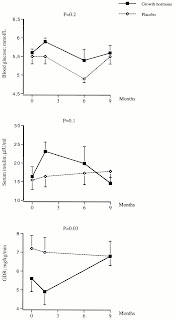
As you can see, insulin sensitivity initially goes down for the GH group, and fasting blood glucose goes up quite a lot. But after 9 months the GH group has better insulin sensitivity. Their GDR is the same as in the placebo group, but with lower circulating insulin. The folks in the GH group also have significantly less body fat, and have better health markers, than those who took the placebo.
There is such a thing as sudden-onset type 2-like diabetes, but it is very rare (see Michael’s blog). Usually type 2 diabetes “telegraphs” its arrival through gradually increasing fasting blood glucose and HbA1c. However, those normally come together with other things, notably a decrease in HDL cholesterol and an increase in fasting triglycerides. Folks who do glycogen-depleting exercise and intermittent fasting tend to see the opposite – an increase in HDL cholesterol and a decrease in triglycerides.
So, if you are doing things that have the potential to increase your GH levels, a standard lipid panel can help you try to figure out whether insulin resistance is benign or not, if it happens.
By the way, GH and cortisol levels are correlated, which is often why some associate responses to glycogen-depleting exercise and intermittent fasting with esoteric nonsense that has no basis in scientific research like “adrenal fatigue”. Cortisol levels are meant to go up and down, but they should not go up and stay up while you are sitting down.
Avoid chronic stress, and keep on doing glycogen-depleting exercise and intermittent fasting; there is overwhelming scientific evidence that these things are good for you.
It is a bit like GH therapy, with GH being “administered” to you by your own body. Both glycogen-depleting exercise and intermittent fasting increase GH levels; apparently they have an additive effect when done together.
Still, a complaint that one sees a lot from people who have been doing glycogen-depleting exercise and intermittent fasting for a while is that their fasting blood glucose levels go up. This is particularly true for obese folks (after they lose body fat), as obesity tends to be associated with low GH levels, although it is not restricted to the obese. In fact, many people decide to stop what they were doing because they think that they are becoming insulin resistant and on their way to developing type 2 diabetes. And, surely enough, when they stop, their blood glucose levels go down.
Guess what? If your blood glucose levels are going up quite a bit in response to glycogen-depleting exercise and intermittent fasting, maybe you are one of the lucky folks who are very effective at increasing their GH levels. The blood glucose increase effect is temporary, although it can last months, and is indeed caused by insulin resistance. An HbA1c test should also show an increase in hemoglobin glycation.
Over time, however, you will very likely become more insulin sensitive. What is happening is compensatory adaptation, with different short-term and long-term responses. In the short term, your body is trying to become a more efficient fat-burning machine, and GH is involved in this adaptation. But in the short term, GH leads to insulin resistance, probably via actions on muscle and fat cells. This gradually improves in the long term, possibly through a concomitant increase in liver insulin sensitivity and glycogen storage capacity.
This is somewhat similar to the response to GH therapy.
The figure below is from Johannsson et al. (1997). It shows what happened in terms of glucose metabolism when a group of obese men were administered recombinant GH for 9 months. The participants were aged 48–66, and were given in daily doses the equivalent to what would be needed to bring their GH levels to approximately what they were at age 20. For glucose, 5 mmol is about 90 mg, 5.5 is about 99, and 6 is about 108. GDR is glucose disposal rate; a measure of how quickly glucose is cleared from the blood.

As you can see, insulin sensitivity initially goes down for the GH group, and fasting blood glucose goes up quite a lot. But after 9 months the GH group has better insulin sensitivity. Their GDR is the same as in the placebo group, but with lower circulating insulin. The folks in the GH group also have significantly less body fat, and have better health markers, than those who took the placebo.
There is such a thing as sudden-onset type 2-like diabetes, but it is very rare (see Michael’s blog). Usually type 2 diabetes “telegraphs” its arrival through gradually increasing fasting blood glucose and HbA1c. However, those normally come together with other things, notably a decrease in HDL cholesterol and an increase in fasting triglycerides. Folks who do glycogen-depleting exercise and intermittent fasting tend to see the opposite – an increase in HDL cholesterol and a decrease in triglycerides.
So, if you are doing things that have the potential to increase your GH levels, a standard lipid panel can help you try to figure out whether insulin resistance is benign or not, if it happens.
By the way, GH and cortisol levels are correlated, which is often why some associate responses to glycogen-depleting exercise and intermittent fasting with esoteric nonsense that has no basis in scientific research like “adrenal fatigue”. Cortisol levels are meant to go up and down, but they should not go up and stay up while you are sitting down.
Avoid chronic stress, and keep on doing glycogen-depleting exercise and intermittent fasting; there is overwhelming scientific evidence that these things are good for you.
Sponsored by:
Subscribe to:
Posts (Atom)