Thursday, 26 March 2015

Is Meat Unhealthy? Consolidated links

Several people have asked for a consolidated list of links to my series on meat and health.  Here it is!  This should make it easier to share.  

Is Meat Unhealthy?  Part I.  Introduction and ethical/environmental considerations.
Is Meat Unhealthy?  Part II.  Our evolutionary history with meat.
Is Meat Unhealthy?  Part III.  Meat and cardiovascular disease.
Is Meat Unhealthy?  Part IV.  Meat and obesity risk.
Is Meat Unhealthy?  Part V.  Meat and type 2 diabetes risk.
Is Meat Unhealthy?  Part VI.  Meat and cancer risk.
Is Meat Unhealthy?  Part VII.  Meat and total mortality.
Is Meat Unhealthy?  Part VIII.  Health vs. the absence of disease.

Sponsored by:
PopAds.net - The Best Popunder Adnetwork

Salted Caramel Oatmeal

Salted. Caramel. Oats. You like the sound of that? Oh yes you do. Having dessert(ish) foods for breakfast is what life is all about. Seriously, if you haven't tried the Creamy Chocolate Oatmeal that I posted some time ago, get on it, NOW! So next up is this sinfully indulgent beast of a breakfast that'll leave you fully satisfied and ready to take on a new day.


This recipe owes its sweetness to date paste, or date caramel as I prefer to call it (see below). I make mine by mashing a few soft dates with a fork but this may not be so easy if you don't have the right kind of dates. The ones I'm talking about here can be seen above; soft, un-pitted ones that are super easy to peel and have a melt-in-your-mouth consistency. If you can't find these where you live, soaking a few of the drier, pre-pitted dates overnight would probably work as well.

Date Caramel
The wonderful, caramel-y flavour comes from the amazing Organic Burst Maca Powder that I've been putting in everything lately. If you don't have any maca at hand then I suggest you sub it for a spoonful of mesquite powder or simply leave it out and let the dates work their caramel magic all on their own.

Salted Caramel Oatmeal


Ingredients:

- 1/2 cup rolled oats


- 1 cup unsweetened almond milk

- 3-4 soft dates with the pits still in them or 3-4 pre-pitted dates soaked overnight (30 g)

- 1/2 tbsp Organic Burst Maca Powder (could sub for mesquite or omit completely)

- Salt to taste

How to:

1. Bring oats, salt and almond milk to the boil (in a small saucepan) then lower the heat to a simmer.

2. Peel (optional) the dates and mash them to a gooey mess using a fork and a spoonful of water.
3. Add the date paste to the saucepan and stir well until the paste has dissolved in the oatmeal.
4. Stir frequently as you wait for the oats to get to the desired consistency. Add in the maca powder right at the end to preserve its nutrients as much as possible.
5. Add toppings such as banana coins and/or peanut butter and serve immediately.

Sponsored by:
PopAds.net - The Best Popunder Adnetwork

Monday, 23 March 2015

A viral cure for cancer only a few years away?


Adopting an evolutionarily sound lifestyle may reduce the probability that one will develop cancer, but there will be those who will nevertheless have cancer. As we live longer lives, cancer diagnoses are likely to become more and more common.

There are viruses that cause the formation and growth of cancer tumors: oncoviruses. However, and quite interestingly, there are also viruses that seek and kill cancer cells: oncolytic viruses. The video below discusses emerging treatments based on oncolytic viruses.


This Penn Medicine YouTube video is about 6 minutes in length. (A previous HBO video was about 40 minutes in length, and it was worth watching in full. However it became unavailable soon after I linked it here. Its title on YouTube was "Vice Special Report: Killing Cancer".)

Cancer treatment via oncolytic viruses had a promising start in the mid-1990s. However, due to technical complications it has been sidelined for years. Interest has been picking up dramatically in recent years. Could it be foundation for the long promised cure for cancer, as the video implies?

Only time and research will tell …

Sponsored by:
PopAds.net - The Best Popunder Adnetwork

Saturday, 14 March 2015

Raspberry and Cherry Crumble Pi(e) for one

Happy pi(e) day! I always love to celebrate otherwise insignificant days that have somehow come to revolve around food. There is National Cinnamon Roll Day (which is kind of a Swedish thing), Mardi Gras, several pancake days and so on. This day in particular kind is so geeky and amazing at the same time that you just can't help but loving it. 

I pondered long on which pie to make. There was an idea of making it a banoffee-thingy lurking somewhere inside my mind, and vegan key lime pie had a certain appeal to it as well. As I was brainstorming, I kind of ran out of time. So what better way to save the day than to whip up an extraordinarily simple crumble pie! All you need is frozen or fresh berries and a couple of pantry staples and you're all set and ready to go!


Before going in the oven


Now, I usually make sure to test my recipes more than once before posting them on here but as there is so little that could possibly go wrong with this, I'll share this recipe before pi(e) day has passed. Let me know if you give it a try!


Raspberry and Cherry Crumble Pi(e) for one


Filling:

- 1 cup (roughly) frozen or fresh berries, I opted for frozen sweet cherries and frozen raspberries

- 1 tbsp cornstarch (potato starch/tapioca flour works as well)

- 1/2-1 tbsp sweetener of choice, such as coconut sugar or erythritol

Crumble:

- 4 tbsp rolled oats

- 1 tbsp coconut flour

- 2-3 dates (24g)

- 1/2 tbsp unsweetened apple sauce

- 1/2 tbsp melted coconut oil

- Pinch of pure vanilla powder

How to:

1. Preheat the oven to 350F/175C
2. Place berries in a bowl and toss in cornstarch until everything is coated.
3. Transfer to a small pie dish and add your sweetener to the berries by sprinkling/pouring it on top. (If you've gone for all sweet berries such as sweet cherries and strawberries, you may want to omit the sweetener.)
4. In another bowl, combine all the ingredients for the crumble -except for 1 tbsp oats- by blending them with a hand blender until a sticky dough forms.
5. Mix the remaining oats into the dough. It should crumble easily and if not, add a bit more liquid/flour until you've reached the right consistency.
6. Sprinkle the crumble evenly on top of the berries and bake in the oven for about 15 minutes or until it starts to brown.
7. Let cool for a few minutes and serve with a few spoonfuls of coconut cream (preferably whipped - mine wasn't) and even more fresh berries if you wish.


Sponsored by:
PopAds.net - The Best Popunder Adnetwork

Friday, 13 March 2015

Food Reward Friday

This week's lucky "winner"... a bacon hot dog donut, by Krispy Kreme!


Read more »

Sponsored by:
PopAds.net - The Best Popunder Adnetwork

Friday, 6 March 2015

Food Reward Friday

This week's lucky "winner"... donuts!!

Krispy Kreme donuts being made.  Hopefully this image isn't appetizing enough to make you want donuts.

Read more »

Sponsored by:
PopAds.net - The Best Popunder Adnetwork

Tuesday, 3 March 2015

Build Your Own Yogurt Maker, Sous-vide Cooker, and All-purpose Fermenter for $40

I make a half gallon of yogurt, twice a month.  I like making my own yogurt for many reasons, but it's a bit of a pain.  Since I make large batches, I can't use a standard yogurt maker.  I often get distracted and over-heat the milk, and the method I use to incubate the yogurt is wildly inefficient (my beloved Excalibur dehydrator).  I also need a constant warm temperature for various other fermentation projects, and that's often difficult to achieve with the tools I have.

I finally found a better solution: a temperature controller that accurately regulates the temperature of a slow cooker by turning an outlet on or off.  I simply set the temperature of the controller, place the temperature probe into the slow cooker, and plug the slow cooker into the temperature controller outlet.  The slow cooker then stays at whatever temperature I want.  Here's what the temperature controller looks like:


Once built, the temperature controller with or without the slow cooker can be used for a variety of other tasks (including regulating cooling devices).  Here are some ideas that come to mind:
  • Sous-vide cooker
  • High-capacity yogurt maker
  • Bread dough riser
  • All-purpose thermophilic fermenter (e.g., for tempeh, natto, koji)
  • Beer/cider/wine fermentation temperature controller
  • Kegerator controller
  • Freezer-to-fridge conversion
  • Egg incubator
  • Soil temperature controller for seed starting
Don't worry, I'm not turning into a food blogger.  But this sous-vide-cooked
chicken I made with my DIY temperature controller was pretty tasty.
I used this recipe from NomNom Paleo.
You can build the whole thing for about $40, including the slow cooker.

Read more »

Sponsored by:
PopAds.net - The Best Popunder Adnetwork

Friday, 27 February 2015

Is Meat Unhealthy? Part IX

Welcome to the last post in the series.  Time to summarize and wrap it up!

Respect

I respect each person's right to choose the diet they prefer.  This includes vegetarians and vegans, particularly because most of them make daily sacrifices to try to make the world a better place for all of us.  I'm an omnivore, but I sympathize with some of the philosophy and I often eat beans or lentils instead of meat*.

Our history with meat

Our ancestors have probably been eating some form of meat continuously for at least two hundred million years.  However, the quantity has waxed and waned.  The first mammals were probably largely carnivorous (insectivores).  Yet our primate ancestors went through a 60-million-year arboreal phase, during which we probably ate fruit, leaves, seeds, insects, and perhaps a little bit of vertebrate meat.  We only outgrew this phase in the last few million years, when we developed the tools and the brains to pursue prey more effectively.

During our 2.6 million-year stint as hominin hunter-gatherers, we ate an omnivorous diet, although we really have very little idea how much meat it contained (it probably varied by time and place).  Historical and contemporary hunter-gatherer cultures are all omnivorous, and typically eat significant to substantial quantities of meat, suggesting that our ancestors may have done the same.  Non-industrial agricultural populations eat as much meat as they can get, although they usually can't get as much as hunter-gatherers.

If there is such thing as a natural human diet, it is clearly omnivorous.

Meat, obesity, and chronic disease

Read more »

Sponsored by:
PopAds.net - The Best Popunder Adnetwork

Monday, 23 February 2015

We Do Science Interview

I recently did an interview with Laurent Bannock, an expert in sport and exercise nutrition.  His podcast We Do Science has rapidly become quite popular, due to Laurent's credibility and the interesting guests he interviews.  We covered body composition, metabolically healthy obesity, the relationship between BMI and mortality, calorie counting, body fat regulation, and other related topics.

If you've already listened to several of my interviews and are starting to find them repetitive, you might enjoy this one because we cover some new ground.  Laurent was a gracious host.  Follow the link below to listen:

Neurobiology of Obesity, with Stephan Guyenet

Sponsored by:
PopAds.net - The Best Popunder Adnetwork

What is the probability that you are NOT diabetic if your fasting blood glucose is 110-126 mg/dl?


Often I hear from readers who have changed their diets and lifestyles toward a more evolutionarily sound direction () that their fasting blood glucose (FBG) readings have gone up. Frequently numbers in the range 110-126 mg/dl (6.1-7 mmol/l) are mentioned.

If you have a FBG reading of 110-126 mg/dl (6.1-7 mmol/l) very likely your doctor will tell you that you are either diabetic or well on your way be becoming diabetic.

Diabetes is a condition that in humans is most frequently associated with damage to the beta cells in the pancreas, significantly impairing insulin secretion. With limited insulin, glucose levels tend to go up, leading to high FBG levels and high glucose peaks after consumption of carbohydrates. The latter, high glucose peaks, appear to be particularly damaging when happening regularly over time.

What is the probability that you are NOT diabetic with this FBG reading?

I put together the table below, based on data from a widely cited meta-analysis () conducted by the research group called The Emerging Risk Factors Collaboration. It shows the distribution of FBG levels in urban settings among individuals who do not have diabetes.


The numbers in this table are fairly consistent with those from various other surveys of large numbers of individuals in urban settings.

The study mentioned above also tells us that the incidence of diabetes in urban populations is in the neighborhood of 6.8 percent. This may not sound like much, but as disease incidences goes, it is very high – approximately 1 in every randomly selected group of 15 people has diabetes.

The vast majority of those diagnosed will have diabetes mellitus type 2, which tends to develop over time and be associated with the metabolic syndrome ().

We know from Bayes' theorem, which is a fundamental element of the increasingly popular Bayesian statistics, that the probability of an event A given that an event B has occurred [denoted P(A|B)] is given by:

P(A|B)=P(B|A)*P(A)/P(B).

In the equation above, P(B|A) is the probability of event B given A, P(A) is the probability of event A, and P(B) is the probability of event B.

To answer the question posed in the title of this blog post, we need to calculate the probability that a person will have no diabetes given that he or she has a fasting blood glucose of 110-126 mg/dl.

Replacing A and B in the equation above with “NoDiabetes” (short for not having diabetes) and “FBG=110-126 mg/dl” respectively, we arrive at the formula to calculate the probability that answers the question:

P(NoDiabetes|FBG=110-126 mg/dl)=P(FBG=110-126 mg/dl|NoDiabetes)*P(NoDiabetes)/P(FBG=110-126 mg/dl).

From the table above we know that P(FBG=110-126 mg/dl|NoDiabetes)=7 percent. From our previous discussion, we know that P(NoDiabetes)=(100-6.8)/100 =93.2 percent.

Finally, the study tells us that P(FBG=110-126 mg/dl) is 9.1 percent. This includes individuals with diabetes (2.1 percent) and without diabetes (7 percent).

With these numbers, we can calculate the probability that a person will have no diabetes given that he or she has a FBG of 110-126 mg/dl:

P(NoDiabetes|FBG=110-126 mg/dl)=0.07*(1-0.068)/0.091=0.72.

That is, if your fasting blood glucose is in the 110-126 mg/dl range (6.1-7 mmol/l) then the probability that you DO NOT have diabetes is 72 percent. It would be much safer to bet that you do not have diabetes than that you do, even at that relatively high range.

Surprising eh!?

The above discussion not only highlights the lack of reliability of fasting blood glucose levels for diabetes diagnoses in the 110-126 mg/dl range (6.1-7 mmol/l), but also begs the question – what could cause high fasting blood glucose levels in healthy individuals?

Some of the folks I heard from have gone through insulin sensitivity tests (see, e.g., ), and were found to be insulin sensitive (in at least one case, highly sensitive), even though their baseline glucose levels are generally high. This goes against the possible speculation that they are prediabetics well on their way to becoming diabetic.

One possibility has been discussed in a previous post, which also mentions what could happen with HbA1c levels ().

Sponsored by:
PopAds.net - The Best Popunder Adnetwork

Friday, 20 February 2015

Food Reward Friday

This week's lucky "winner"... the Cinnabon cinnamon roll!!!

Read more »

Sponsored by:
PopAds.net - The Best Popunder Adnetwork

Monday, 16 February 2015

Can High-Fiber Foods Fight the Metabolic Syndrome?

The metabolic syndrome (MetSyn) is a cluster of signs including abdominal obesity, insulin resistance, high blood pressure, and blood lipid disturbances.  MetSyn is the quintessential modern metabolic disorder, and it affects about one third of Americans.  Many MetSyn diets recommend eating high-fiber foods, and research on the role of the gut microbiota in body weight and health tends to support this recommendation.  Yet these diets are complex, so it's difficult to attribute positive effects to the high-fiber foods specifically, and some people have questioned the benefits of dietary fiber.  Do high-fiber foods really improve MetSyn and promote weight loss?

The study

Read more »

Sponsored by:
PopAds.net - The Best Popunder Adnetwork

Sweet Potato Chocolate Spread

What if I told you that 2 tbsp of this spread provides you with all the vitamin A you need in a day? Sounds too good to be true? Well it isn't. Other than being delicious, sweet potatoes are packed with this super important nutrient that keeps your eyes in good condition and your skin beautifully radiant. Plus this recipe is so simple and quick to make and only requires five ingredients! No excuses!


Ingredients:

2 medium-sized, peeled sweet potatoes (380 g)

3 tbsp melted cacao butter or coconut oil

10 dates (100 g)

2 tbsp cacao or cocoa powder

Pinch of salt


How to:

1. Cube the sweet potato and steam until entirely soft and easy to pierce with a fork, approximately 15-20 minutes.

2. Transfer the cooked sweet potato to a medium-sized bowl, add the remaining ingredients and blend with a hand blender until smooth. This could also be done using a food processor.
3. Spoon up the chocolate spread in a mason jar or any airtight container of your choice and store in the fridge.

Enjoy this spread on peanut butter sandwiches, your oatmeal or eat it straight from the jar with a spoon! (That's what I do...)

Chocolate love from Tilda ♥

Sponsored by:
PopAds.net - The Best Popunder Adnetwork

Friday, 13 February 2015

Is Meat Unhealthy? Part VIII

Health can be defined as the absence of disease, and that is the lens through which we've been examining meat so far.  However, most of us have a broader view of health that also includes optimal growth and development, physical and mental performance, well-being, fertility, immunity, robustness, and resilience.  What role does meat play in this broader view of health?

Non-industrial cultures

One of the things I keep coming back to in this series is the strong natural affinity that our species has for meat.  Every culture that does not prohibit meat consumption for religious reasons (e.g., Indian Hindus) seeks and eats meat avidly.

A key fact that stands out from my recent conversations with anthropologists is that hunter-gatherers and subsistence agriculturalists place a high value on meat, even if they already have regular access to it.  Here's an excerpt from a paper by Kim Hill, Magdalena Hurtado, and colleagues (1):
Observations of the exchange rate between other foragers and their agricultural neighbors indicate that meat is worth much more than carbohydrate calories (e.g., Hart 1978; Peterson 1981). Hart, in his study of exchanges of meat and casava between Pygmy foragers and neighboring agriculturalists, found that approximately four and one half times as many calories of casava were exchanged for each calorie of meat given. In addition, it appears that almost everywhere in the world meat calories from domestic animals are probably expensive to produce relative to plant calories, and yet subsistence farmers continue to use at least some of their "cheap" plant calories to produce "expensive" animal calories (see Harris 1985 for discussion)
Why do humans around the globe value meat so much?  This strongly suggests that we've evolved an affinity for meat because eating it provides a reproductive advantage.  In other words, meat may increase our "Darwinian fitness".

Read more »

Sponsored by:
PopAds.net - The Best Popunder Adnetwork

Monday, 9 February 2015

Asian Salmon

Like anyone, I get bored of eating the same meals all the time and look for ways to add flavor to meals, while still keeping them healthy.  Right now, I'm hooked on this Asian Salmon dish that I've made several times now.  If you try it, please let me know what you think.  The recipe below is for one meal, so make more marinade if you're feeding your whole family.  


Read more »

Sponsored by:
PopAds.net - The Best Popunder Adnetwork

Sunday, 8 February 2015

40-Day Fat Loss Challenge (Day 14 Update)

It's time to check in and update my progress for the 40-Day Fat Loss Challenge I entered at my gym. For my body fat percentage, I'll use my trainer's caliper measure since I won't have access to the machine until the 40 days is up.  The machine measured about the same as my trainer anyway.  My goal is to lose at least 1% body fat each week so that at the end of the 40 days (nearly 6 weeks), I'll have gone from 24% down to 17%.  I'm on track for that now, but would love to get closer to 15%.  

PROGRESS

Day 1:  24% body fat (112.4 pounds)
Day 7:  22.4% body fat (110 pounds) 
Day 14: 21% body fat (109.4 pounds) 
(These numbers reflect what I weigh when I weigh-in at the gym mid-morning.  My weight below I take first thing in the morning when I wake up, so it's slightly lower.) 

Below is a picture of where I'm at as of Day 13.  I didn't take a good "Day 1" picture, so the "start" is from December, but it's a good representation of me on Day 1.  

You're not going to notice a dramatic difference week by week, but over many weeks, and then a couple or few months, you definitely will.  If there's one thing I've learned it's to be patient, take it one day at a time and TRUST THE PROCESS.  If you look carefully, you'll see my arms and tummy are leaning out a little 


Read more »

Sponsored by:
PopAds.net - The Best Popunder Adnetwork

Creamy Dreamy Peanut Butter-Blueberry Sundae


Ice cream:

- 3 ripe bananas, sliced and frozen (300-330 g)


- 3-4 tbsp almond milk

- 1 heaped tbsp Arctic Berries Blueberry Powder

- 1 pinch vanilla powder or extract

Peanut Butter Sauce:

- 1 tbsp peanut flour (or peanut butter)


- 1 tbsp almond milk

- 1 pinch sea salt

Optional:

- Toppings such as mulberries, coconut chips or raw cacao nibs


How to:

1. Start by making the peanut butter sauce: in a small bowl combine the ingredients for the sauce with a fork until you're left with a thick yet runny sauce. Set aside while you make the ice cream.

2. Place all the ice cream ingredients except for the almond milk in a food processor or high speed blender and blend on high*. Blend for approximately 60-90 seconds or until the frozen banana slices have all been broken down to tiny pieces. Stop to scrape down the sides if necessary.
3. Carefully remove the top cap from your blender and slowly pour in the almond milk while blending. Blend on high until smooth and again, stop to scrape down the sides if you need to. Be patient and don't add more liquid unless you really have to. The ice cream will be much creamier and not as runny this way.
4. Spoon the ice cream up in two bowls and drizzle generously with the peanut butter sauce. Top with whatever you desire and eat immediately before it melts! (And feel free to just have it ALL for yourself. That's what I did.)

*I find this the most effective way to get a creamy, completely smooth ice cream but if it seems too complicated to you, simply place all the ice cream ingredients in the blender/food processor and blend until smooth.

Sponsored by:
PopAds.net - The Best Popunder Adnetwork

Friday, 6 February 2015

Berry-Boosted Blueberry Jam (Naturally Sweetened)

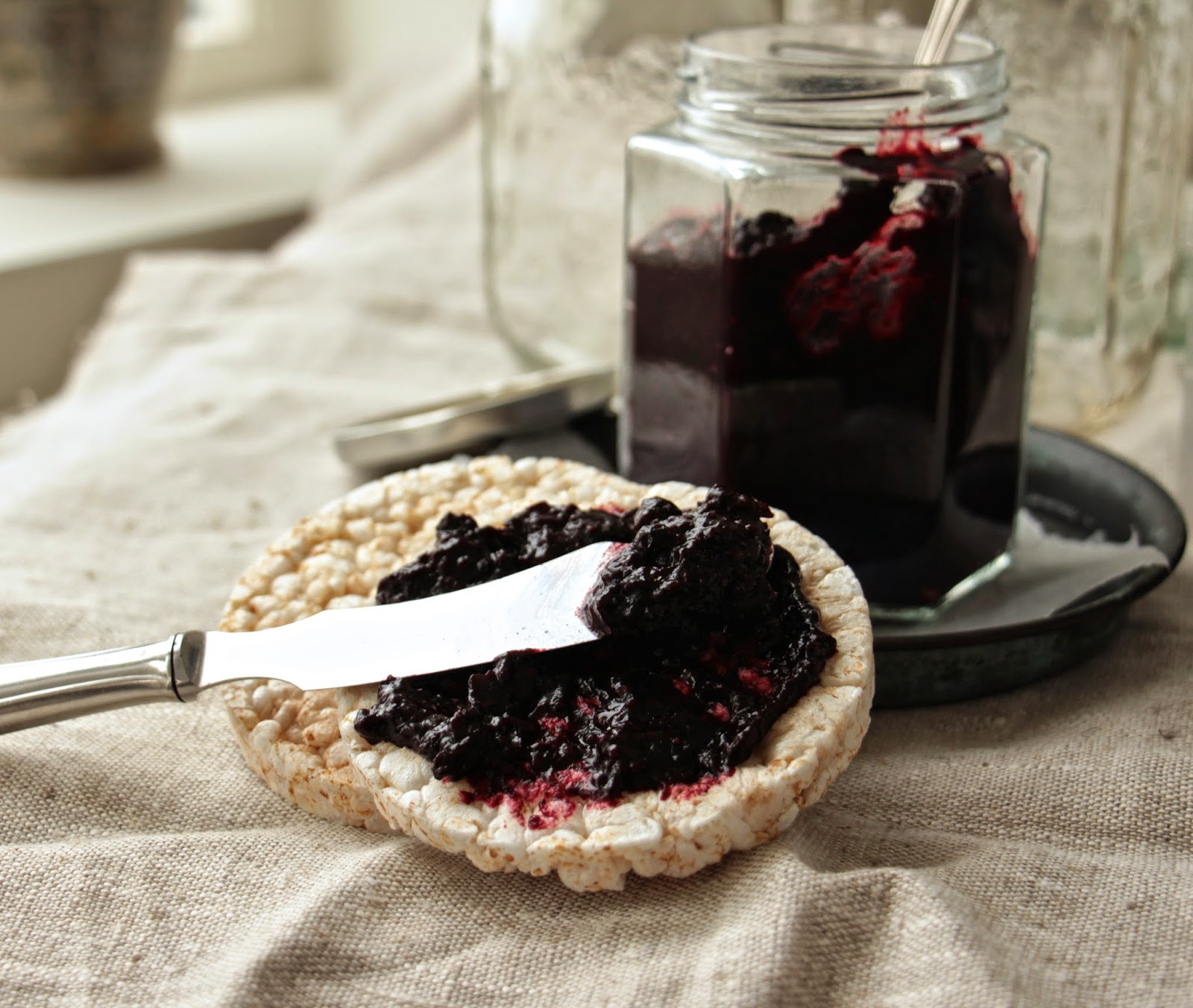
There's something oddly comforting about jam. That sweet, slightly sour taste adds another dimension to basically any carb-y meals. On top of a steaming hot bowl of oatmeal is how we usually enjoy our jam here in Sweden but I have always loved to spread a thick layer of raspberry preserves on top of a crispy, golden brown slice of toast. Mhm. And I know I just said raspberry even though this recipe specifically calls for blueberries. Confession: I didn't like blueberries as a kid. I loved spinach but not blueberries. Yes, I was weird. Moving on.


I must say I'm very pleased with this recipe. It's thick, just like jam is supposed to be. Don't want any of that runny, slimy stuff, no thank you. So it's thick, packs a punch of blueberry flavour only rounded off by a hint of vanilla. I even got my mom hooked on it so now it's a battle against time to have as much as possible for myself before she eats it all up!


Also, I finally got to use a jar from the collection featured throughout this post. To say that I have an obsession with jars is an understatement. This recipe makes one small jar but if you feel like you're likely to finish it soon after making, feel free to double the recipe. You could probably even freeze some for later if you wanted to, even though I haven't tried this myself yet.

Finally I want to point out that this jam is even more nutrient-dense than your average Homemade-healthy-jam all thanks to the Arctic Berries powders! I added some of the blueberry powder and some of the sea buckthorn powder in this but combine them however you want for your own personal touch! Hope you enjoy the recipe!


Berry-Boosted Blueberry Jam

-1/2 lb (225 g) frozen or fresh blueberries

- 6-8 fresh dates (75 g)

- 1/2 tsp pure vanilla powder

- 1/2 tbsp  any Arctic Berries Powder (I used the Sea buckthorn and blueberry powders)

- 1 tbsp chia seeds

How to:

1. Place the blueberries in a small sauce pan and slowly thaw them over medium heat.

2. Meanwhile, pit the dates and put them in a small bowl. Blend the dates with a hand blender until smooth and set aside.
3. Once the berries start to release their juices, bring it up to the boil and let boil for about a minute.
4. Remove the blueberries from the heat and stir in the date paste, vanilla powder and Arctic berries powder(s). If the date paste feels very dense and hard to incorporate into the berry mixture, start by transferring a few tablespoons of blueberry juice into the bowl with the date paste and mix the two to make it a bit looser in consistency.
5. Lastly, stir in the chia seeds and make sure they're evenly divided throughout the jam.
6. Spoon the jam up in a glass jar, seal it and let sit on the countertop to cool off before putting it in the fridge.


My favourite way to eat this jam - thinly spread on top of a rice cake.


Sponsored by:
PopAds.net - The Best Popunder Adnetwork

Best Granola Ever (no oil!)

Prepare yourselves for the crunchiest, sweetest, most delectable granola ever! Though you could never tell from how they taste, these caramel-ly clusters are 100% refined sugar-free and contain no added syrups or oils whatsoever! That's just how we do it around here. ;)


The added nutrient-boost from the sea buckthorn powder gives this granola an extra umph, a je-ne-sais-quoi that is hard to beat. I know that I'm going to add this beautiful orange powder to many more recipes from here on out and after tasting this granola, I hope that you are as well.


Sea Buckthorn & Buckwheat Granola

1 cup raw buckwheat groats (175 g)

1/2 cup quinoa pops (15 g)

1/2 cup raw almonds (75 g)

14 dates, pitted (160 g)

2 tbsp Arctic Berries Sea Buckthorn Powder

2 tbsp water

How to:

1. Pre-heat the oven to 130C.
2. Chop the almonds coarsely and pale them in a large bowl along with the buckwheat groats and quinoa pops.
3. In another, smaller bowl, blend the pitted dates, water and the sea buckthorn powder with a hand blender until completely smooth.
4. Transfer the date paste into the bigger bowl and mix well with the grains and almonds until you have a chunky 'dough'.
5. Bake in the oven for 35 minutes. Remove to stir around every ten minutes to prevent the clusters from burning!
6. To make sure the clusters stay crunchy, leave them in the oven overnight to dry out, preferably with the oven lamp on.
7. Store in an airtight container and enjoy on top of your smoothies, oatmeal, banana ice ream or anything really!


Sponsored by:
PopAds.net - The Best Popunder Adnetwork

Friday, 30 January 2015

How much protein does one need to be in nitrogen balance?

The figure below, from Brooks et al. (2005), shows a graph relating nitrogen balance and protein intake. A nitrogen balance of zero is a state in which body protein mass is stable; that is, it is neither increasing nor decreasing. It seems that the graph was taken from this classic study by Meredith et al. The participants in the study were endurance exercisers. As you can see, age is not much of a factor for nitrogen balance in this group.


Nitrogen balance is greater than zero (i.e., an anabolic state) for the vast majority of the participants at 1.2 g of protein per kg of body weight per day. To convert lbs to kg, divide by 2.2. A person weighing 100 lbs (45 kg) would need 55 g/d of protein; a person weighing 155 lbs (70 kg) would need 84 g/d; someone weighing 200 lbs (91 kg) would need 109 g/d.

The above numbers are overestimations of the amounts needed by people not doing endurance exercise, because endurance exercise tends to lead to muscle loss more than rest or moderate strength training. One way to understand this is compensatory adaptation; the body adapts to endurance exercise by shedding off muscle, as muscle is more of a hindrance than an asset for this type of exercise.

Total calorie intake has a dramatic effect on protein requirements. The above numbers assume that a person is getting just enough calories from other sources to meet daily caloric needs. If a person is in caloric deficit, protein requirements go up. If in caloric surplus, protein requirements go down. Other factors that increase protein requirements are stress and wasting diseases (e.g., cancer).

But what if you want to gain muscle?

Wilson & Wilson (2006) conducted an extensive review of the literature on protein intake and nitrogen balance. That review suggests that a protein intake beyond 25 percent of what is necessary to achieve a nitrogen balance of zero would have no effect on muscle gain. That would be 69 g/d for a person weighing 100 lbs (45 kg); 105 g/d for a person weighing 155 lbs (70 kg); and 136 g/d for someone weighing 200 lbs (91 kg). For the reasons explained above, these are also overestimations.

What if you go well beyond these numbers?

The excess protein will be used primarily as fuel; that is, it will be oxidized. In fact, a large proportion of all the protein consumed on a daily basis is used as fuel, and does not become muscle. This happens even if you are a gifted bodybuilder that can add 1 lb of protein to muscle tissue per month. So excess protein can make you gain body fat, but not by protein becoming body fat.

Dietary protein does not normally become body fat, but will typically be used in place of dietary fat as fuel. This will allow dietary fat to be stored. Dietary protein also leads to an insulin response, which causes less body fat to be released. In this sense, protein has a fat-sparing effect, preventing it from being used to supply the energy needs of the body. As long as it is available, dietary protein will be favored over dietary or body fat as a fuel source.

Having said that, if you were to overeat anything, the best choice would be protein, in the absence of any disease that would be aggravated by this. Why? Protein contributes fewer calories per gram than carbohydrates; many fewer when compared with dietary fat. Unlike carbohydrates or fat, protein almost never becomes body fat under normal circumstances. Dietary fat is very easily converted to body fat; and carbohydrates become body fat when glycogen stores are full. Finally, protein seems to be the most satiating of all macronutrients, perhaps because natural protein-rich foods are also very nutrient-dense.

It is not very easy to eat a lot of protein without getting also a lot of fat if you get your protein from natural foods; as opposed to things like refined seed/grain products or protein supplements. Exceptions are organ meats and seafood, which generally tend to be quite lean and protein-rich.

References

Brooks, G.A., Fahey, T.D., & Baldwin, K.M. (2005). Exercise physiology: Human bioenergetics and its applications. Boston, MA: McGraw-Hill.

Wilson, J., & Wilson, G.J. (2006). Contemporary issues in protein requirements and consumption for resistance trained athletes. Journal of the International Society of Sports Nutrition, 3(1), 7-27.

Sponsored by:
PopAds.net - The Best Popunder Adnetwork